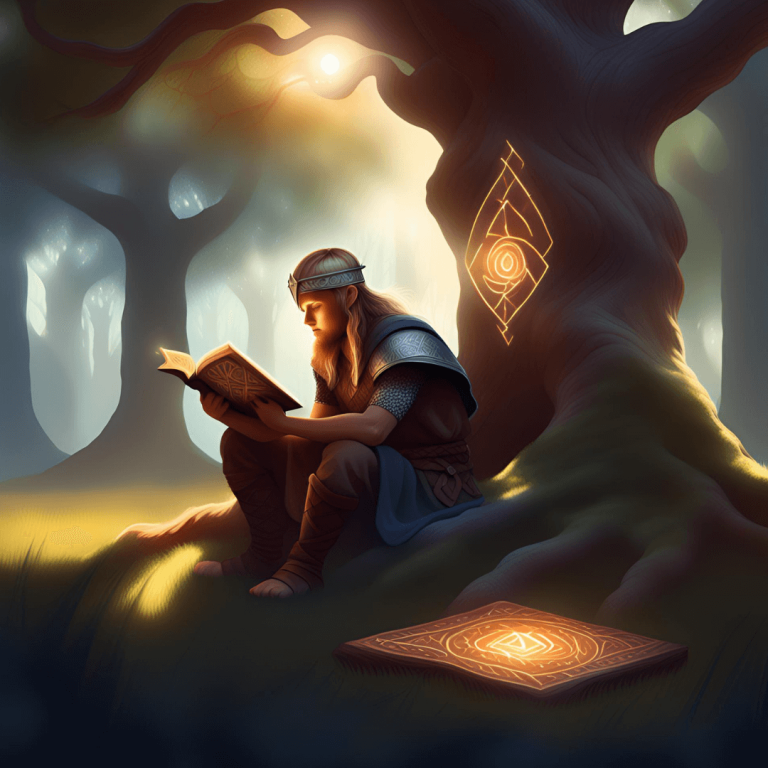

Runes are not just the letters of an ancient alphabet; they are also symbols. Each one is like a key that holds deep meanings. However, it can be difficult to memorize a letter or symbol on its own. This is exactly why combining runes with stories strengthens them in our memory. The most effective way to understand a symbol is to associate it with an event, a character, or a journey. Stories bring abstract concepts to life, making them concrete and unforgettable. For this reason, we have created a narrative for each rune. Our heroes, just like us, discover deep meanings with each rune as they embark on their inner journeys. This way, when you look at a rune, you will not only see a shape but also remember the story hidden within it.
Are you ready to feel the wisdom that runes offer, instead of just seeing them as symbols? Then let’s embark on this journey together.
 Once upon a time, in an ancient Viking village, there lived a wise woman named Freyja. Her hands held the power of abundance, turning whatever they touched into wealth. People would flock to her village to wear clothes made from the wool of her sheep and eat bread made from the wheat she grew. One day, the village faced a severe famine. The fields dried up, and the animals grew weak. But Freyja did not lose hope. In her hand, she held a shepherd’s staff that resembled the shape of the Fehu rune. That night, she raised the staff to the sky and prayed to the gods for abundance. The next morning, the sunlight revived the soil, the animals thrived, and prosperity returned to the village. People saw Freyja’s rune, Fehu, as a symbol of abundance, wealth, and the values that must be protected. From that day on, Fehu represented golden wheat fields, herds of cattle, prosperity, earnings, and success. At the same time, it reminded them that this wealth needed to be wisely managed—just as Freyja cultivated her land with care to continuously reap abundance. (Shape: It can be thought of as a shepherd’s staff or a fence, like a barrier protecting goods and possessions.)
 The Viking village, blessed by Fehu, was now thriving with abundance. However, one day, cold storms from distant lands shook the fields, rivers overflowed, and the people of the village had to become stronger to survive. In Freyja’s village, there was a young shepherd named Ulf. It was his duty to protect the herds of cattle, symbolized by Fehu. One day, while grazing his herds, he saw a massive auroch (wild ox). This giant creature, capable of crossing mountains and rivers, was a symbol of the untamed power of nature. Ulf followed the auroch. As he walked in its path, he began to feel stronger and braver. He crossed fast-flowing rivers and paths battered by storms. Finally, at the edge of a cliff, the auroch stopped and looked back at Ulf. In that moment, Ulf realized that this wild power resided within him too. Gathering his courage, he stood beside the animal. He was no longer just a shepherd, but a warrior who had discovered his inner strength. When he returned to his village, he was no longer the weak child he once was. He had become a leader who would protect Fehu’s abundance and carry the strength of Uruz. He taught the people how to live in harmony with the wild power of nature. From that day on, Uruz became the symbol of physical strength, endurance, and transformation. (Shape: It can be likened to the curved horns of an ox or a strong door.)
 Freyja’s village continued to grow with the abundance of Fehu and the strength of Uruz, but like all powers, this one also attracted an enemy. One night, a loud noise was heard coming from the dark forest. This noise was the sign that a herd of wild creatures, made up of monsters, was approaching. The villagers were uneasy because these creatures could destroy Fehu’s abundance and overpower Uruz’s strength. Ulf, determined to protect the village safeguarded by Fehu and Uruz, made a plan. That night, in an ancient passage, he invoked the power of the Thurisaz rune to complete his preparations. Thurisaz was the symbol of giants and enemies, but it also represented the strength needed to resist these dangers. Thurisaz appeared to Ulf as a shield and sword. The shield symbolized the walls around the village, while the sword represented the power to defend and attack in the face of danger. With the first light of dawn, Ulf donned his shield and sword and set out toward the forest. The forest was so dark that almost nothing could be seen. But when Ulf held the powerful shield of Thurisaz, he felt brave, determined, and protected. Soon, the giant monsters appeared. But Ulf, raising Thurisaz’s shield, repelled them. As he cut through the obstacles with his sword, he broke the strength of his enemies and began to return to his village. That day, Thurisaz would remain not only as a symbol of overcoming obstacles but also as a symbol of proper defense. (Shape: It can be likened to a shield and sword.)
 Life in the village continued with the abundance of Fehu and the strength of Uruz. However, Ulf had realized that physical strength and protection were no longer enough. To sustain the village’s prosperity, they also needed the right knowledge and guidance. One day, an old traveler arrived at their village. He was weary and aged, but there was a light of wisdom in his eyes. Ulf greeted him and did everything he could to help. The traveler explained the power of the Ansuz rune to Ulf. Ansuz was the rune of speech, knowledge, teaching, and inspiration. It was also a symbol of the messenger from the gods and supernatural guidance. The two parallel lines in the Ansuz symbol clearly represented the union of two different thoughts or two worlds. This rune emphasized the importance of the right words and wise communication. Understanding Ansuz allowed one to uncover their inner wisdom and influence the surrounding world through effective communication. The traveler told Ulf, “Being strong is not enough, you must also speak the truth and listen to the truth.” Ulf kept these words in mind and listened to the traveler. Ansuz taught him that he needed to develop not only his words but also his ability to see and hear. Ulf began to strengthen his communication with the people of the village. He became not only a warrior but also the leader, sage, and advisor of the village. One day, a great decision had to be made in the village. Everyone had different opinions, and a deadlock occurred. Using the power of Ansuz, Ulf helped each individual have a voice. He brought together different ideas, understood what everyone thought, and united the people with the right words. In the end, the villagers came together and made a decision together. (Shape: It symbolizes the union of two different thoughts or worlds. Sometimes it also resembles a person with an open mouth, symbolizing a speaker.)
 Ulf had created a great balance by using Fehu’s abundance, Uruz’s strength, Thurisaz’s protection, and Ansuz’s light of wisdom for the safety of his village. However, there was still an emptiness within him. It was time for him to embark on a journey to lead his people, who had achieved success together, to a better future. Ulf was no longer just a defender; he had to become a leader who was also on a journey. One morning, he saw a sign in the mountains surrounding the village, a light that corresponded to the power of the Raido rune. Raido is the rune of travel and the road, but it represents not only a physical journey but also an inner transformation and development process. The symbol of Raido, the shape of a path, can sometimes be thought of as an intersection of roads. It symbolizes the changing directions and junctions along the way. It is also a symbol of strong movement and continuous progress. It acts like a guide, leading one in the right direction with every step of the journey. This represented the beginning of the journey to discover the meaning of life. Ulf decided to perform a test to understand the power of Raido. One morning, he set off toward the deep forests outside the village. He felt a great awakening within him. Raido was symbolizing not only the external journey but also the internal one. As he ventured deeper into the forest, he gained more inspiration with every step and discovered the courage and wisdom in his heart. One night, he thought he had lost his way in the forest, but at that moment, the light of Raido showed him the right direction. Raido symbolized staying on the right path and eventually reaching the goal, even when faced with constantly changing directions and challenges. Ulf found the way, but more importantly, he discovered himself on his inner journey. (Shape: The shape of a path, sometimes symbolizing a road junction.)
 After Ulf’s journey with Raido, he returned to his village and realized that everything began not outside, but within his inner world. Fehu’s abundance, Uruz’s strength, Thurisaz’s protection, Ansuz’s wisdom, and Raido’s path had prepared him, but now Kenaz would allow him to discover a new fire. One night, he decided to awaken his creative power. Kenaz is the symbol of fire, but not just physical fire—it’s also inner enlightenment and creative energy. Ulf entered a cave, holding a torch bearing the symbol of Kenaz. The torch was a source of enlightenment and inspiration, but the only thing that could awaken the inner fire was accepting freedom and creativity. At first, Ulf couldn’t do anything. However, when he turned the power within Kenaz inward and descended into the depths of his soul, he discovered his inner light. The torch lit up, and everything became clear in the dark cave. In that moment, he realized he had shed the burdens of the past and found his own creativity. There were no obstacles—only unlimited potential and creative power. Ulf shared the light of Kenaz with the other villagers, helping them find their own inner fire. This fire was not only physical but also an emotional and mental strength. The creative aspects of the people began to emerge, and art and crafts were revived. (Shape: An open lantern, a flame, or a torch symbol.)
 After discovering the inner light of Kenaz, Ulf continued to illuminate the village by sharing his creative power and potential with the people. However, something was missing. He knew that everything could be achieved through inner strength alone, but he had yet to fully understand the power of connection and sharing. Gebo arrived as a gift to the villagers to bring this balance. One morning, wooden gift boxes appeared in the village center. On the boxes, the symbol of Gebo was carved—two intersecting lines—representing mutual exchange and connection. Ulf realized that these boxes contained gifts that people could offer to one another. However, the true meaning of a gift was not just in giving but also in receiving. Because Gebo symbolizes balance in sharing. Ulf opened one of the boxes and found a handcrafted stone sculpture inside. This sculpture symbolized the power of connection and exchange. As the villagers gave gifts to one another, they realized that receiving was just as valuable as giving. This exchange was not only about physical gifts but also about emotional bonds and mutual understanding. As the villagers shared with one another, they built deeper connections and a sense of belonging. Through Gebo, Ulf discovered true balance: one must share their own power and light with others, but also accept the strength of others in return.(Shape: Like the letter “X,” symbolizing a handshake, the balance between two sides, and the mutual bond established through connection.)
 After Ulf discovered the fire of Kenaz, he shared his creative power with the villagers, and through Gebo, they formed a bond with each other. However, the peace and connection in the village led to the need for a celebration. The community had to come together to celebrate their victories and unity. Wunjo symbolized this celebration. One morning, colorful flags were waving in the village square. Everyone gathered to celebrate the village’s shared victory. Ulf called the villagers together and said, ‘Tonight, let’s celebrate with joy and togetherness. Our journey has been completed through the bond and trust we’ve shown one another. Today, we will celebrate our victory!’ By sunset, the villagers began to dance and sing with joy. Wunjo symbolized not only personal happiness but also societal harmony and celebration. Every individual felt the strength of being together with the community. This joyful moment of collective celebration crowned the victory after all the hardships. Throughout the night, lights shone in the village, and joy spread to every corner. The light of Wunjo filled the village, as everyone congratulated each other and shared in their victories together. Ulf felt immense joy in celebrating both his inner peace and the connections within the community. (Shape: Like a flag waving in the wind.)
 After the celebrations in the village, Ulf felt peaceful, but one morning, the sky darkened, and the winds began to blow fiercely. The earth trembled, and trees fell. The storm had arrived. The villagers, filled with fear, took shelter in their homes. Ulf knew that this storm would bring a great change, not only outside but also within. Hagalaz symbolized not only external destruction but also inner storms. Hagalaz was not just a dark moment; it was also a sign of rebirth. Ulf gathered the villagers and said, ‘This storm may seem like a moment when everything will be lost, but we must not forget that every destruction brings a new birth. This is not just an external destruction but an opportunity for internal change as well. Challenges remind us of our inner strength.’ The storm continued for a long time, but eventually, the earth reshaped itself. The trees had fallen, but new seeds had been sown. Ulf understood the truth of Hagalaz once again: difficulties and destructions are necessary for the next step. Inner strength and rebirth emerge after every calamity. When the storm passed, the villagers came together again. The earth began to grow green once more, the trees began to grow again, and the village was stronger. Ulf, as Hagalaz had taught him, understood that within every destruction lay the opportunity for rebirth. (Two parallel lines: These lines symbolize opposing forces and their continuous process of transformation into a balance. Horizontal line: This line represents how destruction and change ultimately transform into a unifying force.)
 One day, Ulf and the villagers were faced with a great drought. No rain had fallen, and the earth had cracked. At that time, the villagers needed fire not only to cook and stay warm but also as a symbol of their spiritual strength. Fire symbolized their resilience in the face of challenges. However, obtaining fire would not be easy, for there was no wood or spark to ignite it in the village. One day, Eira, the oldest woman in the village, approached Ulf with her aged eyes and said, ‘Nauthiz comes with friction. You must be patient to make fire. There are times when everything requires strength and endurance. To create fire, you must rub sticks together. This friction may initially cause discomfort, but if you persist with patience and determination, you will catch the fire.’ Ulf listened carefully to Eira’s words. Life, like rubbing sticks together, was sometimes filled with challenges. The friction could be uncomfortable, but the key was to overcome these difficulties with patience. Inspired by Eira’s wisdom, Ulf began the fire-making ritual with the villagers. The sticks began to slide in their hands, and the sound of friction echoed loudly. At first, nothing happened. As the friction and tension increased, some villagers were on the verge of giving up. But Ulf, remembering Eira’s words, urged them to be patient: ‘Remember, every friction brings us closer to the fire. Let’s be patient!’ Over time, the friction between the sticks created sparks. The sparks finally caught fire and grew into a large flame. The villagers gathered around the fire, dancing joyfully, but they all knew very well that lighting this fire required patience and perseverance. (Shape: Two sticks rubbed together to create fire.)
 One winter morning, Ulf and the villagers faced a massive snowstorm. Everything was blanketed in white, and the roads were blocked. The villagers were frightened; their food supplies were running low, and their animals were buried under the snow. This was the moment when Isa rune would manifest in full force. Ulf told the villagers to stay calm and wait for the snowstorm to pass. Eira, the elderly woman’s words still echoed in Ulf’s mind: ‘Sometimes life feels as cold as ice. We encounter stillness. But remember, everything has its time. Sometimes, we need to stop, be patient, and find balance. Even snowflakes fall patiently in the cold.’ Inspired by Eira’s words, Ulf taught the villagers that they needed to stay still with patience. The snowstorm grew fiercer, but Ulf advised his people to move with the stillness and calm brought by the Isa rune. Waiting patiently in the face of challenges and obstacles would give them the composure they needed. For a week, the snowstorm didn’t subside. The villagers huddled inside, battling the cold. But every day, Ulf reminded them to stay patient and balanced, as the message of the Isa rune indicated: everything had its timing. The snowstorm would pass. Finally, one morning, the sun rose. The snow slowly melted, and the roads were cleared. When the storm calmed, the villagers, thanks to the calmness and patience the Isa rune had provided, had overcome all the difficulties. The snow remained outside like a beautiful cover, but now, they were stronger inside.(Shape: A single stick, resembling an ice pillar! No movement, everything frozen.)
 As the harvest season approached in the village, Ulf visited the fields he and the villagers had tended to all year. Like every year, the fields were planted, labor was invested, but this time, Ulf noticed something: the Jera rune, while still part of the natural cycle, seemed to remind the villagers that they were becoming impatient. They wanted the fruits of their labor immediately, but Jera would teach them the value of waiting patiently. One day, Ulf went to see the elderly woman, Eira, to learn a lesson. Eira spoke to him, saying, ‘Ulf, to resist the cycle of time is to go against nature. Jera teaches us to wait patiently, and in due time, the harvest will appear. Everything has its moment. All the effort put into the fields throughout the year will now transform into the harvest.’ Ulf reflected on Eira’s words and decided to hold a gathering to explain the meaning of Jera to the villagers. ‘This year,’ he said, ‘working the land is one thing, but being patient and allowing this effort to follow the natural cycle is another. What we must do is align ourselves with nature’s rhythm and wait patiently for the abundance Jera offers.’ The villagers decided to embrace patience and wait for the harvest season. Time passed, and the village worked diligently, ultimately reaping a bountiful harvest. The soil rewarded their efforts, and everything grew plentiful and healthy. Jera symbolized the time when the villagers received the fruits of their patience and labor. When harvest time arrived, they honored the natural cycle of agriculture and celebrated the abundance. (Shape: Two rotating wheels, symbolizing the changing seasons and the arrival of harvest.)
 “After waiting patiently, Ulf had felt the power of the Jera rune and brought great abundance to his village. The harvest from the fields, worked with effort, was plentiful enough to feed each family. However, within Ulf, there was a void. Yes, the outside world was filled with success and abundance, but he could not find his inner peace. Jera had taught him how to patiently receive the fruits of his labor, but now he needed to find balance and connection within himself. One evening, as Ulf was walking near the boundary of the village, an old man approached him and said: ‘Eiwaz is waiting for you, Ulf. Now is the time to connect with your inner world. The abundance of the outer world gains meaning when it is anchored in inner balance. Eiwaz will show you this connection and strength.’ At first, Ulf did not fully understand the old man’s words, but he realized that something needed to change in order to fill the emptiness inside him. Reflecting on the old man’s words, Ulf thought of the Eiwaz rune. Eiwaz symbolized inner connection, balance, and a strong protection against the external world. Early the next morning, Ulf set out for the deep woods. Eiwaz reminded him that he needed to journey into his inner world and find new connections to discover his inner balance. As he walked through the forest, Ulf envisioned the symbol of Eiwaz in his mind: A tree with roots deep in the earth, reaching toward the sky with its branches. With each step, Ulf imagined this symbol. The roots went deep, toward the heart of the earth. As he connected with this imagery, Ulf discovered his inner strength and began to feel balance within himself. Just as the roots of a tree extend deep into the ground, Ulf felt himself reaching toward the sky, toward higher consciousness. The confusion in his mind began to clear. Eiwaz was teaching him how to build a bridge between his inner world and the outer world. Having found his inner strength, Ulf was now able to protect the world around him more powerfully, having harvested the fruits of his patience and hard work. (This symbol resembles the tree’s roots and branches, representing the tree of destiny, connecting above and below.)”
 After learning inner balance and protection through the Eiwaz rune, Ulf had harvested the fruits of his patience and made his village stronger. But there was still something missing—something mysterious or secret. Even though everything was progressing smoothly, the void within him was not entirely filled. In his consciousness, something seemed to be stirring in his subconscious, telling him that he needed to discover his destiny. One evening, while walking through the depths of the forest, Ulf encountered the wise Eira again. Her face bore the depth of ancient wisdom. “Ulf, now you must understand Perthro,” she said. “The time has come for you to descend into the depths of your destiny.” Perthro was known as a rune of mystery, subconscious connections, and the discovery of life’s meaning. Ulf had learned each rune in his inner journey, but Perthro would teach him something beyond what he had already learned. Now, he needed to question how much control he truly had, and sometimes surrender to the hands of fate. Reflecting on Eira’s words, Ulf ventured further into the forest. On a stormy night, while gazing at the trunk of a tree, the symbol of Perthro appeared before him. As a symbol of a die and its uncertainty, Perthro suggested taking control of destiny out of the human hand, leading one into a journey guided by the subconscious mind. Ulf did not fully understand the meaning of the symbol, but suddenly a mystery unfolded. It was like rolling a die—the future was uncertain, and everything was tied to chance. Every decision and step he took was subject to fate’s game. Sitting on a stone in the depths of the forest, Ulf closed his eyes and listened to his inner voice. Perthro granted him not only the power to question the future but also the past. Perhaps the choices he had made in the past shaped his present life, or perhaps everything was in the hands of destiny. It was like rolling a die, where he could never truly know the outcome. After a while, Ulf realized that Perthro was teaching him one thing: the truth that life is sometimes uncertain, and everything lies in the hands of fate. Sometimes, making a choice, or accepting something, was about moving forward with the opportunities and challenges that life presented. Everything that fate brought him was a new lesson, a new discovery. (This symbol looks like an overturned container or a die-throwing cup, as if something is about to be poured from it.)
 After discovering Perthro, Ulf had learned to delve into the depths of destiny and accept uncertainty. However, there was still something that gnawed at him—a sense of impending danger. As he made his way back to the village, he began to see the symbol of Algiz in his mind when he looked up at the night sky. It signaled that the time had come for protection. One day, a strange mist appeared near the village. Ulf felt that this mist was not just a natural occurrence—it felt like a warning. One night, Eira appeared once again and said to Ulf: “Algiz is coming to protect you. You must unleash your inner strength and protect your village. This mist is not just an external threat; it can also create an internal void. Protect yourself and stay strong.” Ulf paused for a moment, contemplating her words. He tried to connect with the symbol of Algiz, a rune associated with protection, defense, and spiritual strength. Like the wings of a bird, like a protective shield, Algiz would grant him the power to find his inner strength and withstand the dangers surrounding him. As Ulf ventured outside the village, he sensed that something waited within the mist. Algiz was telling him to prepare his defense. Confronting an external danger also meant facing his own internal darkness. He continued forward, remembering his inner strength. He imagined a bird soaring into the sky, its wings, symbolizing protection and freedom, growing large and strong. The mist approached rapidly, and Ulf realized that this was not just a physical danger—it was creating a spiritual void. But with the power of Algiz, he faced this threat with courage. Using the sense of protection and spiritual defense within him, he pressed on toward the village. When he reached the village, the mist began to dissipate. But Ulf realized that the true danger was not outside—it was within. Algiz had granted him inner defense and strength, allowing him to overcome the external threat. True protection, he understood, came not from defending against outer dangers but from guarding against the voids in one’s inner world. (This symbol looks like a bird spreading its wings in defense, or like a person opening their arms to shield another.)
 Since the beginning of his journey, Ulf had developed an inner awareness. However, one morning, he woke up to a light he had never seen before. As he watched the sunrise through his bedroom window, he suddenly noticed something completely different. This was not an ordinary sunrise. He felt Sowilo. The sun was rising as it always did, but this time its light was different. At that moment, he realized that the light carried a deeper meaning. The sunlight had merged with the power of Sowilo. It wasn’t just heat and light; it was like an explosion of light. Ulf felt the sun’s rays and simultaneously experienced the sudden and powerful impact of lightning in his soul. Both powers, merging within the Sowilo rune, were showing him the right path with the constant power of the sun and the sudden light of lightning.
Ulf met with Elder Thorvald, one of the oldest in the village. Thorvald was known for guiding the villagers with his wise words. When Ulf explained the reason for his inner restlessness, Thorvald smiled and said: “Many people see the sun only as a constant light. But it can also be a light that strikes like lightning. True power lies in being able to use Sowilo to its fullest. It is both a strong, stable light and a light powerful enough to create sudden change.” Ulf was deeply moved by these words. Thorvald’s advice echoed in his mind. Sowilo was teaching him to use both of these powers at once. Sometimes he needed to feel the sun’s heat patiently, and at other times, he had to unleash the sudden impact of lightning at the right moment. One day, a great danger appeared in his village. They were warned of an approaching storm. The villagers were hesitant and filled with fear. As Ulf thought about this dangerous situation, he felt the power that Sowilo’s light had awakened within him. This was the sun’s patient light, but it was also the sudden, swift power of lightning. His inner light was so strong that he believed even the clouds in the sky could retreat. Ulf walked toward the fearful villagers. Just then, a flash of lightning struck in the dark sky. Ulf paused for a moment. His eyes sparkled, and he took a deep breath. By unleashing the light of the sun within him, he moved quickly, like a flash of lightning. He decided to fight against the clouds in the sky. Feeling Sowilo, he brought forth the power of the light, both steady like the sun and sudden like lightning. As the storm approached, Ulf combined both powers and took another step. He created a balance between the sun’s light and the sudden effect of lightning. Suddenly, like an explosion of light, he sent a powerful energy toward the sky. Shortly after, the dark clouds that had been looming over the village were replaced by a sun that had broken through. The storm vanished, and the power of Sowilo illuminated everything around the village. (Shape: A lightning-shaped curling sunbeam. It illuminates and gives power!)
 Ulf’s journey had been long and arduous. With each rune he encountered, he discovered more of the power within him. With Sowilo, he found his light, and with Uruz, he discovered his inner strength. However, the rune he faced this time would not only grant him strength but also instill in him the spirit of defending the truth and fighting with courage. One morning, as Ulf walked toward his village, he heard a voice. Following the source of the sound, he came upon a crowd gathered in the village’s large square. At the center stood the village leader, Elder Thorvald. Thorvald had brought a criminal before the people and was speaking loudly about the need for justice to be served. Ulf blended into the crowd and began listening. The criminal was a farmer who had set fire to his neighbor’s field. Thorvald demanded that, according to the village laws, the criminal be punished. However, the one giving the punishment knew that justice had to be carried out correctly. Ulf carefully studied the criminal with his eyes. He believed that justice had to be served, but he also knew that he had to be wise enough to discern right from wrong. Thorvald turned to the crowd and said, “Justice is sometimes forceful, but it ensures balance in all things. The criminal must be punished.” Ulf realized that justice was not just about punishment. The message of Tiwaz was not merely about winning victory or using force; it was about demonstrating the right action and ensuring justice was served. When Ulf felt the Tiwaz symbol, he became a warrior. The warriors of Tiwaz were those who would sacrifice themselves to see justice fulfilled. This rune gave him the strength to act with courage and to defend the truth with selflessness. Instead of always seeking victory in battle, he had to ensure that everything was correct and balanced. This was a principle that nourished the warrior spirit within him. Ulf approached the village leader and asked for the right to speak. The crowd fell silent, and Ulf took a deep breath before speaking: “Elder Thorvald, we cannot find justice only by punishing. If we ignore a person’s soul, their mistakes, and their regrets, we have not truly achieved justice. The criminal must face punishment, but the community must also give them a chance. Justice should not only favor the righteous but should also include the one who truly repents and strives to change. As I feel the power of Tiwaz, I realize that battle is not just about physical victory; it is also about spiritual victory. To be a warrior requires selflessness and the defense of what is right.” Thorvald, as he listened to Ulf’s words, remembered the warrior spirit within himself. Tiwaz reminded him that victory was not just won through physical battle, but through defending what is right and attaining a spiritual victory. Finally, Thorvald nodded his head, signaling that he agreed with Ulf’s words. “Justice sometimes requires not just power and courage, but also understanding and patience,” he said. (Shape: It appears like a straight arrow pointing upward, resembling a sword that represents justice!)
 After a long journey, Ulf reached the foot of the high mountains. In front of him stood a massive mountain with two peaks. The summits resembled an open door, leaving a passage in the center. This shape reminded him of something: Berkana! The rune’s sharp, angular lines were just like the two peaks of the mountain. But it wasn’t just a passage—it was like a protective womb. Ulf noticed that within these mountains was a valley covered in dense forests. As he stepped inside, he was met with a fertile, life-filled world. Trees, birds, flowers… it was as if he had sought refuge in the embrace of nature. Suddenly, a spark ignited in his mind. Berkana was not just a passage—it was a force that birthed and nurtured life. Just like a mother carries her child in her womb, this valley was giving life to countless beings within it. The soil was fertile, the waters abundant, and nature was constantly growing. Wasn’t life like this? Moving through challenges was like a process of birth. Birth was painful, but in the end, there was rebirth, growth, and strength. Ulf walked through the valley for a while. This place was not just a sanctuary; it was also the center of rebirth and transformation. (Shape: A mountain with two peaks: The angular lines of Berkana can be thought of as two mountain peaks standing side by side. Between these mountains, there is a passage, just like the gateway to birth and new beginnings. A protective womb: The shape of Berkana resembles the interior of a protective womb. This is a place where new beginnings safely take root.)
 When Ulf left the Berkana Valley, he saw the vast lands stretching before him. Walking alone was difficult. Just then, he noticed a pair of horses running together in the distance. One was like the reflection of the other in a mirror. Their steps were in perfect harmony—when one sped up, the other did as well; when one stopped, the other paused too. This sight reminded Ulf of the shape of the Ehwaz rune. Two parallel lines represented the motion of two beings working in unison. They weren’t separate beings; they were parts of a whole, moving together in trust and harmony. As Ulf watched the horses, he understood: True progress doesn’t happen alone—it happens with someone you can trust. Just like a rider trusting their horse, or two friends walking shoulder to shoulder… The horses paused for a moment, nudged each other’s heads, and then started running together again. This was the meaning of Ehwaz: Moving together, advancing in harmony, supporting one another. (Shape: Ehwaz’s two parallel lines represent the two horses running side by side or two souls in harmony.)
 After a long journey, Ulf and his loyal horse reached the top of a hill. Below was a village. People worked in the fields, children played, and the elderly chatted in the shade. Ulf paused for a moment and pondered: What is a human? Just then, he saw the Mannaz rune carved into a large stone in the village square. This symbol, resembling two figures facing each other, reminded him of a mirror. As he wandered through the village, he observed the relationships between the people. A person could not be human alone; it was through others that one found meaning. Just like the two lines of Mannaz leaning against each other… One could not exist without the other. Ulf stopped by a well. When he looked into the water, he saw his own reflection. But not only himself—he saw the children playing, the people walking in the distance. To be human was not just to see oneself, but to see others as well. In that moment, he realized that Mannaz represented not only the individual but all of humanity, the shared consciousness, and collective growth. (Shape: It resembles two people holding hands, symbolizing societal connections.)
 After spending a few days in the village, Ulf continued on his journey. In front of him lay a vast river. Its water was clear and calm, yet hidden beneath the surface was a strong current. He hesitated, standing on the shore. Should he cross the river? Just then, he leaned over and saw his reflection on the surface of the water. But his image wasn’t steady—the shape shifted with each ripple, sometimes clear, sometimes blurred. It was like the Laguz rune… Fluid, constantly changing, yet always finding a path. An old woman approached the shore, holding a clay pitcher, and drew water from the river. She turned to Ulf and said, “You cannot resist the water, you must flow with it. Strength is not about standing rigidly; it’s trusting the flow. But the power of water is not just in its current; it’s in the depths that nourish your intuition.” Ulf paused for a moment. He realized that it wasn’t his body but his mind that needed to swim in this river. If he could be flexible and adaptable like water, he could complete his journey. Laguz reminded him of the flow—both the flow of life and the inner intuition. Just as he was about to step into the water, he felt a moment of doubt. A feeling rose from deep within; it was telling him that the undercurrents were strong, and he couldn’t just walk across. He looked around and noticed a log floating a little further along the water. An instinct whispered for him to follow it. Holding onto the log, he navigated through the strong currents, crossing the river safely. In that moment, he understood that intuition, like water, was an invisible yet felt force. If he trusted it and found his way through his inner voice, he could overcome even the most challenging passages. (Shape: The winding flow of a river.)
 As Ulf continued on his journey, each new symbol he encountered deepened his understanding, and eventually, he came upon Ingwaz. Slowly, he knelt down and traced his hand over the symbol. This symbol represented a closed, unified structure. A distinct awareness sparked in his eyes. Ingwaz was a shape that held within it a powerful potential, like a seed growing life inside it. The symbol represented a box, a containing space. This container appeared to be hidden from the outside, keeping its strength safely within. Suddenly, the patience he had learned from his past journeys came to mind. Like a seed, he had learned to grow himself slowly, to mature with time. Just as a seed takes root beneath the earth and eventually sprouts, sometimes in life, waiting and maturing were necessary. The potential within him had to wait for the right time to emerge. Instead of bursting out quickly, it had to first grow internally, take root, and gain strength. Discovering one’s potential was like a seed growing over time. It symbolized a life that, though seemingly dormant under the soil, was maturing powerfully. Ingwaz was a symbol of patience, waiting for the right moment to release the strength contained within. As Ulf pondered the meaning of this symbol, he realized that he needed to wait to find his true strength. Over time, and with the right development, this power would eventually set everything in its place. (Ingwaz’s shape can be interpreted as a seed buried in the ground. It appears small and closed from the outside, but it holds great strength within.)
 One morning, as Ulf awoke with the first light of the day, he experienced a profound inner awareness. The Dagaz symbol appeared before him. This symbol, formed by the union of two triangles, was like the wings of a butterfly opening—heralding a new beginning and transformation. Ulf realized that, like a butterfly, he was ready to emerge from the dark cocoon of his past. He recognized that the difficult and dark times he had endured were over, and now he could fly toward a bright future. Dagaz symbolized the emergence of his inner potential, the cleansing of the darkness of the past, and rebirth. Ulf thought about the transformation a butterfly undergoes when it leaves its cocoon. A butterfly spends years in the darkness of its cocoon, waiting patiently. Then, one day, it spreads its wings toward the light and is freed. The Dagaz symbol conveyed exactly this message. The struggles, limitations, and fears were now behind him. It was time to embrace freedom and move toward inner enlightenment. Dagaz represented a process where patience was rewarded. Ulf realized that the dark times of his past had been necessary for bringing out his inner potential. The patient waiting in the cocoon was part of the self-discovery and growth process. And now, like the butterfly, it was time to fly toward the light. Dagaz also symbolized the dawn of a new day. Just as the day breaks, leaving the night behind, Ulf was leaving his dark period behind and rebirthing himself. The butterfly, after a dark period, spreads its colorful wings and flies toward the light. Dagaz symbolized this rebirth and ascension, just as the butterfly spreads its wings in freedom. Dagaz is a symbol of rebirth, inner transformation, patience, and the return to light. By noticing this symbol, Ulf understood that he had shed the constraints and darkness of the past and had become free. He was stepping toward new beginnings and a bright future. (Shape: Like a butterfly opening its wings.)
 As Ulf completed his transformation in the light of Dagaz, he still felt a sense of incompleteness. He had found a new path, but it felt as though he had severed all ties to his past. Yet, to understand who he was, he also needed to know where he came from. At that moment, the symbol of Othala appeared in his mind: Lines converging like a roof, supported by pillars on either side… It was a house. A home. An inheritance. He recalled the stories his grandfather had told him as a child. Their ancestors had fought to protect these lands, passing down their knowledge to future generations. Every stone, every tree, every tradition was a legacy handed down by his forebears. It was not only the land but the memory of a lineage. He paused for a moment, thinking: True inheritance was not only about land and possessions. Traditions, teachings, and values were also part of that legacy. The wisdom passed down from his ancestors was a responsibility placed upon his shoulders. Now, Ulf understood his task. He had to carry this knowledge, protect it, and one day pass it on to his children, and their children after them. For the true inheritance lay within the individual. And to preserve that legacy, Ulf now knew where he truly belonged. (Shape: Like the roof and walls of a house.)
You can check the following link to read the meanings of the runes without the story.
Link: https://www.spiritualuna.com/rune-information/24-runic-symbol/